
Constantly tired & exhausted
HPU-Diagnosis
Click on the test
HPU/KPU diagnosis is made via urine analysis.
Pyrrole determination by Medivere
Pyroluria Urine Test by medivere:
Order here, simply click on the test.
These are the points you should consider before taking the test.





Don’t drink alcohol the day before your HPU test.
My tip: If you suffer from symptoms typical of HPU, it’s advisable to avoid alcohol altogether. Alcohol is a liver toxin, and HPU is a detoxification disorder.

Do not test within the first four weeks after an iron infusion. The test will then be negative.
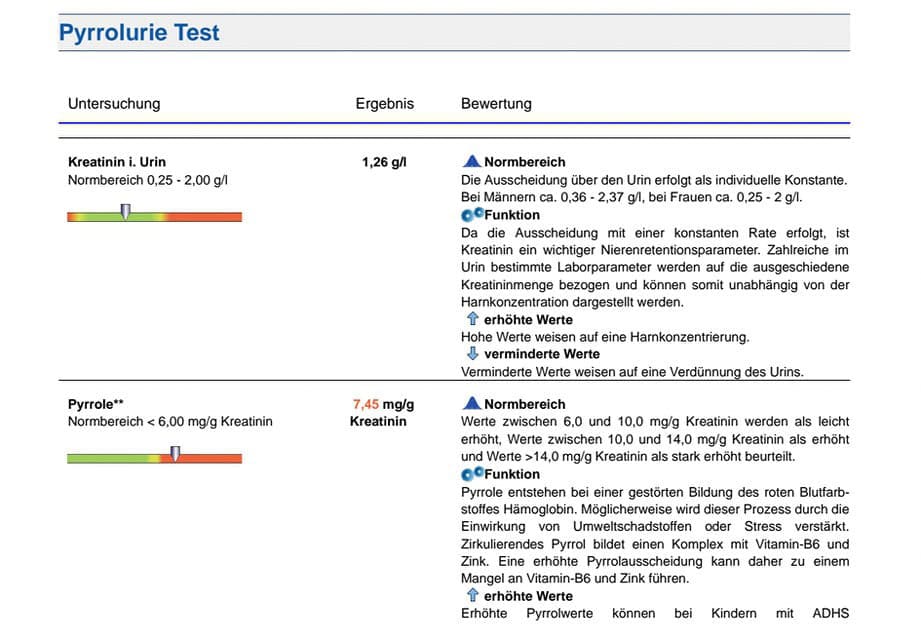
Why a micronutrient analysis is not sufficient for diagnosing HPU
The following blood values may (but do not necessarily) indicate HPU:
Homocysteine increased
LDL and cholesterol levels are elevated
Reduced white blood cell count
Decreased erythrocytes
Zinc reduced
P5P (active form of vitamin B6) decreases, while simultaneously high vitamin B6 levels in the blood serum are present.
What is the difference between HPU and KPU?
HPU and KPU are both disorders of heme metabolism and are treated the same. Therefore, differentiating between testing for HPU and KPU is not helpful for those affected. In the USA, both disorders are referred to as “pyroluria.” I recommend this term in German-speaking countries as well.
KPU
Full Name: Kryptopyrroluria
Common Term:
Pyrroluria
Substance Detected in Urine:
2,4-Dimethyl-3-Ethylpyrrole
Treatment: almost identical
HPU
Full Name: Hemopyrrollactamuria (HPU)
Common Term:
Pyrroluria
Substance Detected in Urine:
5-Hydroxy-Hemopyrrollactam Zinc Chelate Complex
Treatment: almost identical
From the blog

Correctly measuring vitamin B6 and B12
A question that comes up again and again in the HPUandYou Facebook Group is: How should I test my B-vitamin levels, especially Vitamin B12 and B6? I discussed this topic with Dr....

Water filters for HPU: Do I need to filter my drinking water?
Drinking Water Filters Anyone dealing with the metabolic disorder with the hard-to-pronounce name Hämopyrrollaktamuria (HPU for short) quickly realizes that it is not only about...
Correctly measuring vitamin B6 and B12
A question that comes up again and again in the HPUandYou Facebook Group is: How should I test my B-vitamin levels, especially Vitamin B12 and B6? I discussed this topic with Dr....