

Drinking Water Filters
Anyone dealing with the metabolic disorder with the hard-to-pronounce name Hämopyrrollaktamuria (HPU for short) quickly realizes that it is not only about getting the body’s detoxification system back on track, but also about minimizing the body’s exposure to toxins as much as possible. Since drinking water plays an important role in this, I first asked myself what actually comes out of German taps.
On the website of the German Consumer Advice Center I found statements such as:
“Drinking water in Germany is of consistently good quality and can be consumed without concern.”
And:
“In some drinking waters, due to widespread distribution and massive use of pharmaceuticals and pesticides, minimal traces of individual pollutants can be detected in water, far below the permitted limit values and considered harmless even with daily consumption.”
(https://www.verbraucherzentrale.de/wissen/umwelt-haushalt/wasser/sind-pestizide-und-medikamente-im-leitungswasser-34837, article dated 08.01.24)
A wide range of concerning substances in drinking water
I then came across an article from the German Medical Journal (Ärzteblatt) from 2018. It states:
“Pharmaceutical residues and micro-pollutants contaminate drinking water and thus potentially the health of the population. The Federal Environment Agency is now calling for a fourth treatment stage in wastewater plants. At the same time, numerous institutes are working on new elimination methods.”
Apparently, our drinking water is already contaminated with concerning amounts of pharmaceuticals and other pollutants that wastewater treatment plants are currently unable to fully remove. The article continues:
“The annual consumption of human pharmaceuticals in Germany is estimated at 30,000 tons and includes 300 active substances. Around 100 of them are considered harmless, as they belong to electrolytes, peptides, vitamins, etc., and are therefore excluded from environmental assessment. However, about 200 pharmaceutical active substances remain from an annual consumption of around 8,100 tons that are environmentally relevant and potentially harmful. In addition to the ‘blockbuster’ diclofenac, among the most widely used substances worldwide are the antiepileptic carbamazepine, the painkiller ibuprofen, the contraceptive hormone ethinylestradiol, and the antibiotic sulfamethoxazole.”
Well… that’s not something I want to drink either. But how can these substances be removed from water?
Activated carbon filters are suitable for removing pharmaceuticals and pesticides
The article describes it as follows:
“Through additional oxidation with ozone and/or adsorption using activated carbon filters, chemicals could be efficiently removed from wastewater. This is urgently needed, as a large number of substances have long-term environmental impacts.”
My selection criteria for a good water filter
The market for water filter manufacturers is large and confusing. When I was searching for a good filter, the following criteria were particularly important to me. The filter should:
- work based on activated carbon to remove pharmaceutical residues,
- retain minerals in the water,
- have certified filtration performance (because claims alone are not enough),
- be proven free of chemical additives,
- be made from renewable raw materials (since I want to protect myself from pollutants without harming the environment),
- not be prone to bacterial contamination, and
- have a reasonable price.
During my research, the Hamburg-based company “The Local Water” stood out. The two founders place great emphasis on quality and verified filtration performance—because anyone can make claims.
Reverse osmosis system?
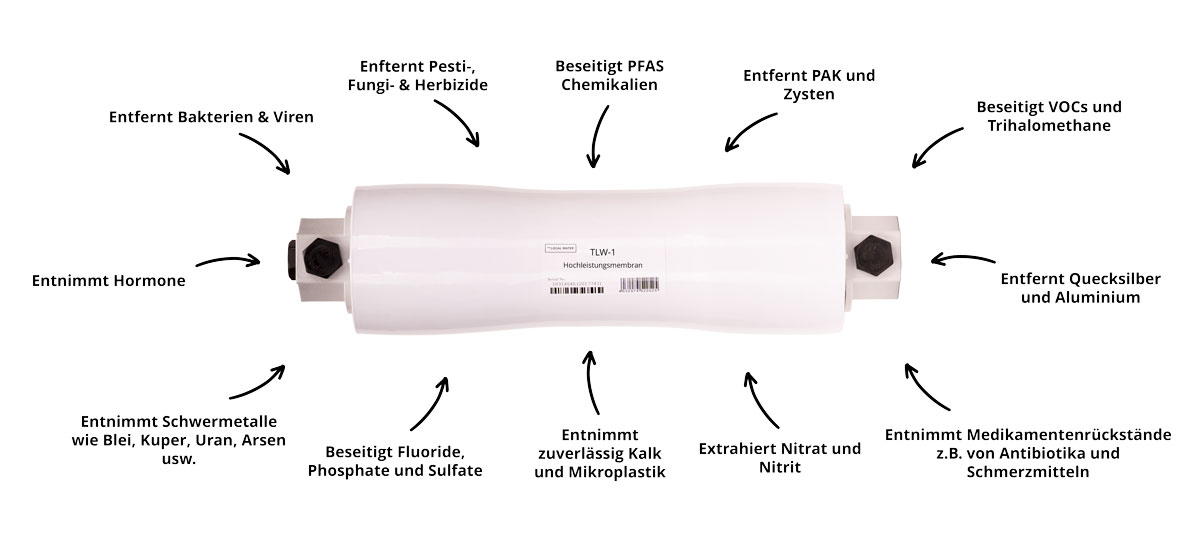
A reverse osmosis system can remove an extremely wide range of substances from water. This includes chlorine, PFAS, nitrites, nitrates, sulfates, phosphates, and arsenic. Essentially, such a system only allows water molecules to pass through the membrane. Since no minerals remain in the water after filtration, it can optionally be remineralized—or minerals can simply be obtained through a balanced diet.
There are many systems on the market. What matters is that the membrane is designed by someone with real expertise. Additionally, all components should be free of plasticizers, otherwise the freshly purified water could be contaminated again. The Hamburg-based company The Local Water produces its filters in small batches with handcrafted manufacturing in Germany, unlike many others produced in Asia.
The perfect water filter?
I don’t believe THE perfect water filter exists. Everyone has to decide which filtration system suits their needs. A reverse osmosis system offers the highest level of filtration and leaves almost pure H₂O. However, this comes at a cost (devices from The Local Water start at around €1,200).
For people who do not want to invest that much initially, they offer a different filter:
- based on activated carbon from coconut shells,
- with filtration performance confirmed by 12 reports, certifications, and long-term studies,
- filtering water to 99.99% free of bacteria, pharmaceutical residues, hormones, pesticide breakdown products, and more,
- retaining minerals in the water,
- filtering up to 10,000 liters per cartridge,
- available from €49 for 6 months (plus a one-time housing cost from €200).

I also chose this filter myself, specifically the built-in version (“Startup Base“). Although it is about €80 more expensive than the countertop version, it integrates more elegantly into my kitchen. The housing is now also available in stainless steel.

Built-in water filter before installation

15-minute installation of the water filter on the cold-water supply of the tap.
Do you need a new faucet with a water filter?
An activated carbon filter can only filter cold water. Since water flows through many layers of activated carbon, water pressure is significantly reduced. Filtered water therefore always comes out cold and with low pressure.
If this is inconvenient, you can either install a second faucet for filtered water or choose a more elegant solution: a three-way faucet. This allows you to switch between filtered cold water (low pressure) and unfiltered water (normal pressure). The latter can then be mixed with hot water as usual.
Initially, I kept my existing faucet. After one year, I upgraded to a three-way faucet because the reduced pressure made rinsing less convenient.
My conclusion:
For my needs, the water filter from “The Local Water” meets all the criteria of a good water filtration system. And the best part—I almost forgot—is that the water tastes very good, also according to my husband and children.
Why this company in particular?
The filtration systems are all made in Germany and tested for a lifespan of over 50 years. They are guaranteed to be free from harmful substances such as PFAS, formaldehyde, and bisphenol A (BPA).
Thanks to internationally recognized medical certifications (FDA, USP Class VI, and ISO 10993-5 / -10 / -11), consumers get maximum assurance that the water is truly clean.
Discount for HPU patients
I have arranged a small benefit with The Local Water for you. With the code HPUandYou5, you get 5% discount on filters, fittings, and energizers.