
Constantly tired & exhausted
HPU test?
KPU test?
What the pyrrole test
really measures
In short: what you should know about the HPU test
Constantly tired, exhausted, oversensitive – and at some point you come across the terms HPU and KPU. Perhaps a therapist has even recommended a test. But what exactly is measured? And what does the result tell you?
Here you get an honest answer – even where science does not yet have a final one.
The HPU test and the KPU test measure the same thing: pyrroles in the first morning urine.
HPU and KPU are not recognised diagnoses. What exactly lies behind them has not yet been scientifically clarified.
An elevated pyrrole level can be a sign of increased oxidative stress – meaning that your body needs support.
The test is a starting point, not an end point. Further lab tests show where exactly your metabolism needs support.
HPU, KPU, pyroluria – three names for one open question
Since the 1960s, researchers have observed that some people excrete noticeably high amounts of certain substances in their urine that turn purple in a colour reaction with the so-called Ehrlich reagent – back then called the “mauve factor”. To this day, it has not been conclusively established which substance exactly is behind it.
KPU
Full name: Kryptopyrroluria
Original assumption (1969): the substance in the urine is kryptopyrrole.
HPU
Full name: Hemopyrrollactamuria
Later assumption (1978): it is a hemopyrrole breakdown product, HPL.
Everyone agrees on one point: the urine of some people contains pyrrole-like compounds that show the typical purple colour change. That is exactly what the test measures. Normally, breakdown products of the red blood pigment (heme) are excreted via the bile in the stool – with an elevated pyrrole level, additional pyrrole compounds end up in the urine.
A review from 2021 concludes that the existing studies are not sufficient to describe a clearly defined clinical picture (Warren et al., 2021). This is why medivere, for example, has renamed its test: the “HPU test” has become the pyrrole test. The method has stayed the same – only the name now describes more precisely what is measured.
What this means for you: whether your test is called “HPU test”, “KPU test” or “pyrrole test” is mainly a question of the name. In practice, the approach is very similar for both.
What does an elevated pyrrole level mean?
An elevated level is not a diagnosis. It is a lab finding that you should take seriously.
One explanatory model: pyrroles in the urine are linked to increased oxidative stress. Researchers at the Queensland University of Technology describe pyrroles as a possible biomarker for oxidative stress: they assume that physical and psychological stress lead to an excess of aggressive oxygen compounds. These break down heme components, and the fragments end up in the urine as pyrroles (Lambert et al., 2023). This, too, is still a hypothesis.
In an older study, higher pyrrole levels went hand in hand with lower levels of the body’s own protective substances (glutathione, catalase) (McGinnis et al., 2008). This is a correlation, not yet proof of cause and effect. The GANZIMMUN laboratory also names environmental pollutants and stress factors such as nitrosative stress as possible triggers (technical information 0077).
Put simply, oxidative stress means that the body produces more aggressive oxygen compounds than it can neutralise. And this is where the metabolism needs support.
Why the pyrrole test alone is not enough
The test shows you that your body is under pressure – but not where. That is why further lab tests make sense. Not everyone affected shows the same abnormalities. This is exactly why it is worth looking at your individual values instead of taking supplements across the board.
Click on the test
How the pyrrole test works
- Order the test – the test kit is delivered to your home.
- Prepare – see the checklist below.
- Collect your first morning urine and send it to the lab.
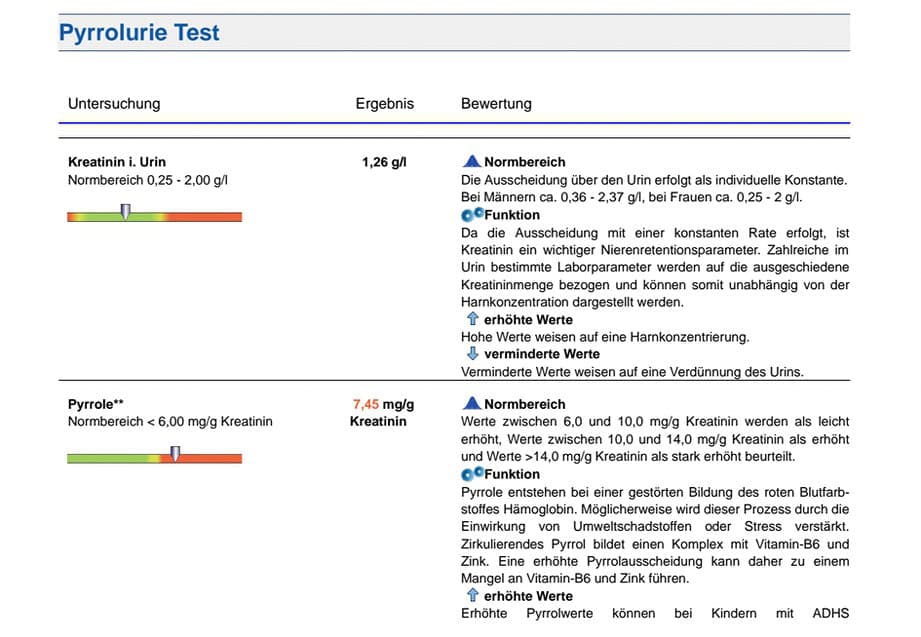
- Receive your result – with a reference value (urine concentration) and your pyrrole level.
Pyrrole test by medivere
I recommend the pyrrole test by medivere (formerly “HPU test”; the method has stayed the same). The sample is analysed in the ISO-certified GANZIMMUN laboratory in Mainz, Germany. The test costs about 30 euros.
Order here – simply click on the test

Checklist: how to prepare for the HPU test





Don’t drink alcohol the day before your HPU test.
My tip: If you suffer from symptoms typical of HPU, it’s advisable to avoid alcohol altogether. Alcohol puts additional strain on the liver.

Important: A value just above or below the limit is not a clear “yes” or “no”. What matters is the overall picture of symptoms and further lab values.
Frequently asked questions about the HPU and KPU test
What is the difference between the HPU test and the KPU test?
Both measure pyrroles in the urine, which is why the test is now often simply called the pyrrole test. The names come from different research approaches in the 1960s and 1970s. Which substance exactly is measured has not yet been conclusively established scientifically.
Is HPU a recognised disease?
No. HPU and KPU are not recognised as diseases in conventional medicine. However, an elevated pyrrole level can be a sign of increased oxidative stress and a reason to take a closer look.
How much does an HPU test cost?
The pyrrole test costs about 30 euros. In Germany, statutory health insurance usually does not cover the costs.
Can I do the HPU test myself at home?
Yes. You order a test kit, collect your first morning urine and send the sample to the lab.
What should I do if my pyrrole level is elevated?
Have further lab values checked to see where your metabolism needs support – ideally with an experienced therapist or in one of my courses.
Can a blood test detect HPU?
No. Blood values such as zinc, P5P or homocysteine can provide clues, but they are not specific. The pyrrole level is measured in the urine.
Sources
- Irvine DG et al. (1969): Nature 224, 811–813.
- Irvine DG (1978): Hydroxy-hemopyrrolenone, not kryptopyrrole, in the urine of schizophrenics and porphyrics. Clinical Chemistry 24(11), 2069–2070.
- McGinnis WR et al. (2008): Discerning the Mauve Factor, Part 1. Altern Ther Health Med 14(2), 40–50. PubMed
- Warren B, Sarris J, Mulder RT, Rucklidge JJ (2021): Pyroluria: Fact or Fiction? J Altern Complement Med 27(5), 407–415. doi:10.1089/acm.2020.0151
- Lambert B, Semmler A, Beer C, Voisey J (2023): Pyrroles as a Potential Biomarker for Oxidative Stress Disorders. Int J Mol Sci 24(3), 2712. doi:10.3390/ijms24032712
- medivere / GANZIMMUN: Technical information 0077 „Hämopyrrolurie (HPU)“ (German).

From the blog

Correctly measuring vitamin B6 and B12
A question that comes up again and again in the HPUandYou Facebook Group is: How should I test my B-vitamin levels, especially Vitamin B12 and B6? I discussed this topic with Dr....

Water filters for HPU: Do I need to filter my drinking water?
Drinking Water Filters Anyone dealing with the metabolic disorder with the hard-to-pronounce name Hämopyrrollaktamuria (HPU for short) quickly realizes that it is not only about...
Correctly measuring vitamin B6 and B12
A question that comes up again and again in the HPUandYou Facebook Group is: How should I test my B-vitamin levels, especially Vitamin B12 and B6? I discussed this topic with Dr....